

HealifyNow provides some of the services discussed in this article. Our content is written to inform, and clinical decisions are always made by a licensed clinician.
“Am I eligible to have a service animal?” It’s one of the most frequent questions people ask, but the information available on the Internet often makes the matter unclear. For example, some resources provide a small number of disabilities as if it’s an official list. Some other sources say that you should obtain a certificate or doctor’s recommendation.
In fact, everything is much simpler and wider. There is no official list of disabilities which are allowed. This resource provides information on what the Americans with Disabilities Act (ADA) considers disability to be, types of allowed disabilities, tasks service dogs do for these disabilities, types of disabilities that aren’t allowed, and how you can determine where you belong.
How the ADA Defines Disability
According to the ADA, disability is a physical or mental impairment that significantly limits major life activities. The major life activities include the following:
- Walking, standing, lifting, and bending
- Seeing and hearing
- Breathing and eating
- Sleeping
- Learning, reading, and concentrating
- Thinking and communicating
- Interacting with others
- Caring for yourself
- Working
The ADA acknowledges episodic or remitted impairments which would have caused substantial limitations if they were active. Such provisions apply to medical conditions such as epilepsy, PTSD, or multiple sclerosis, where symptoms are recurring.
What Makes a Dog a Service Dog?
It is important to note that having a disability does not qualify an animal to be a service dog. The following two conditions should apply for an animal to qualify as a service animal:
- An individual has a disability as defined above.
- The animal is specifically trained to perform certain tasks for the individual as a result of their disability.
Having an animal provide comfort to an individual qualifies the animal to be an emotional support animal.
No Official List of Qualifying Conditions
No list of approved diagnoses is provided by the ADA. However, one being diagnosed does not automatically make them eligible. This brings us to the issue of how the condition affects one’s everyday life and if the trained tasks make a difference. That’s why individuals who have the same diagnosis may give two different answers.
Here we present categories of conditions that may be used to meet the eligibility criteria, as well as the tasks the trained dog may perform for them.
Physical and Mobility Disabilities
Conditions that affect movement, strength, or balance, such as:
- Spinal cord injury and paralysis
- Cerebral palsy
- Muscular dystrophy
- Multiple sclerosis (MS)
- Arthritis and chronic joint conditions
- Amputation or limb differences
- Conditions affecting balance and coordination
- Chronic pain conditions that limit mobility
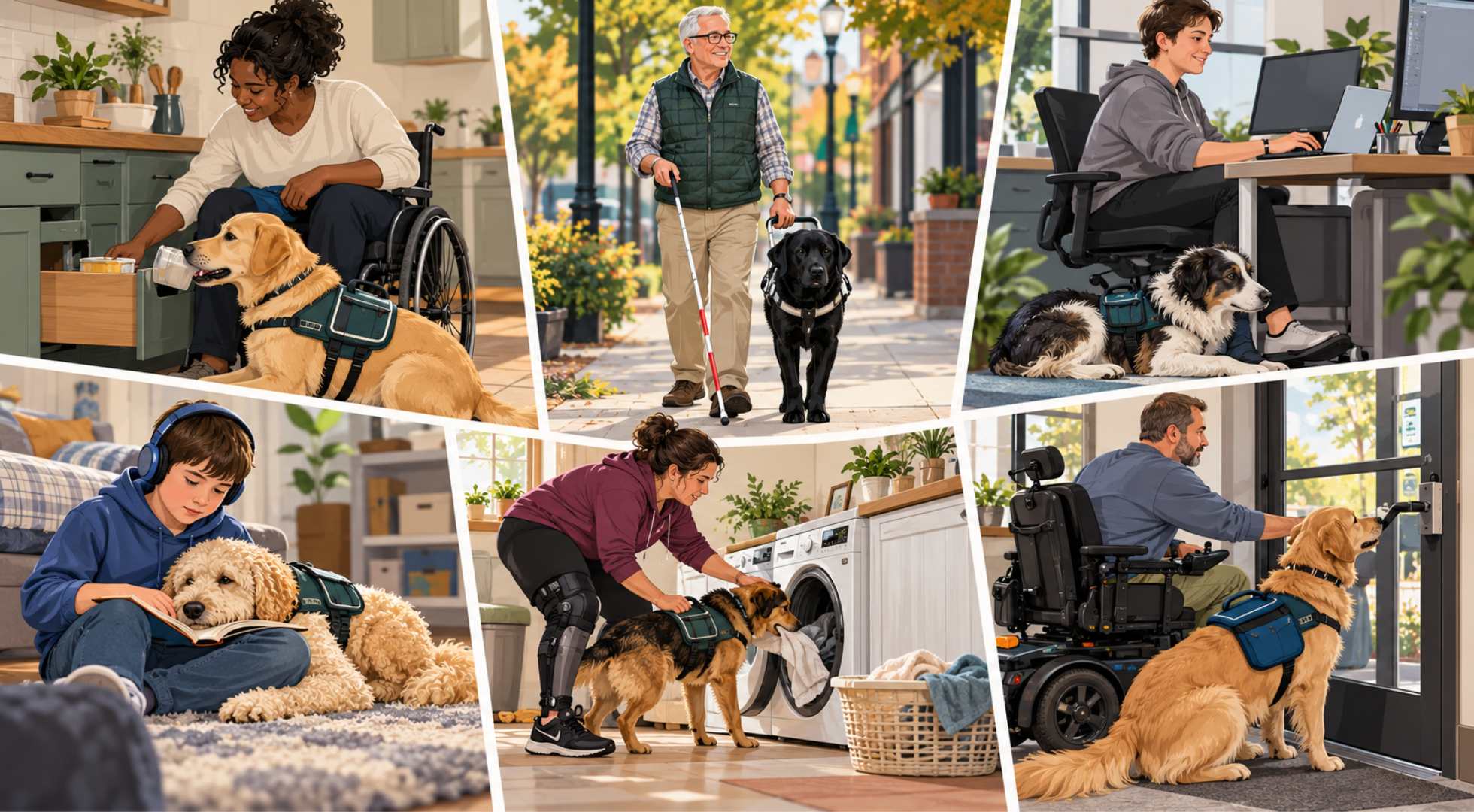
Possible tasks: Retrieving dropped items, opening and closing doors, turning lights on and off, pulling a manual wheelchair, helping with balance or counterbalance (with a veterinarian-approved, structurally sound dog), assisting with dressing, and fetching help.
Sensory Disabilities
Vision: Blindness or low vision.
- Tasks: Guiding around obstacles, stopping at curbs and stairs, and navigating safely.
Hearing: Deafness or being hard of hearing.
- Tasks: Alerting to alarms, doorbells, a knock, a baby crying, or someone calling the person’s name.
Neurological Conditions
- Epilepsy and seizure disorders
- Multiple sclerosis
- Parkinson’s disease
- Traumatic brain injury (TBI)
- Migraine conditions that substantially limit activity
- Narcolepsy
Possible tasks: Staying with an individual during the seizure attack, helping out, bringing the medication, offering stability, fetching objects, and warning about certain incidents. Some dogs are trained for warning about the coming seizures, but it’s hard to predict them and it depends on a dog.
Medical Conditions
Factors affecting your health which need observation or intervention include the following:
- Type I diabetes mellitus and other difficult-to-manage types of diabetes
- Peanut allergy and other severe allergic reactions
- POTS (Postural orthostatic tachycardia syndrome) and other dizziness/fainting problems
- Heart and blood pressure problems leading to fainting
- Severe fatigue and other factors limiting your ability to do normal activities
Possible tasks: Blood glucose level warning, detection of particular allergens, retrieval of medicines or cell phone, warning about fainting, and getting help.
Odor-related and predictive alerts require special training, and reliability may differ from one dog to another. Such dogs are meant to be used alongside, but not instead of, professional medical services.
Psychiatric and Mental Health Disabilities
Psychiatric conditions can qualify when symptoms substantially limit a major life activity. Examples include:
- Post-traumatic stress disorder (PTSD)
- Severe anxiety, panic disorder, and agoraphobia
- Major depression
- Bipolar disorder
- Obsessive-compulsive disorder (OCD)
- Schizophrenia and related conditions
- Dissociative disorders
- Severe social anxiety
Possible tasks: Deep Pressure Therapy, disrupting panic or repetitive behavior, waking someone from nightmares, grounding when dissociating or experiencing flashbacks, providing space in crowds, room check, medication reminders, and taking someone to a place of safety or somewhere private.
See our guides to a psychiatric service dog for anxiety and an ESA for veterans with PTSD.
Developmental and Cognitive Disabilities
- Autism
- Intellectual disabilities
- Dementia and Alzheimer’s disease
- Learning and cognitive disabilities that substantially limit daily life
Possible tasks: Interrupting repetitive behaviors, deep pressure during overwhelm, grounding in sensory overload, alerting a caregiver, safety-related tasks, and reminders or routine support. See our guide to a psychiatric service dog for autism.
Other Conditions
Many other types of disorders may qualify where the disability significantly impairs one or more of the major life activities and a dog may be trained to do useful work. These include autoimmune disorders, chronic illnesses, and even invisible disabilities. The main issue will always be whether the disorder substantially impairs any major life activity and useful tasks can be taught to assist the individual.
What Doesn’t Qualify
- Comfort alone. A dog that comforts just by being there is an ESA, not a service dog.
- Deterrent or protection. The ADA does not recognize protection or the presence of a dog as a qualifying task.
- Loneliness or general stress that does not substantially limit a major life activity.
- Minor or temporary impairments that do not substantially limit daily activities.
- Normal pet behavior, like being friendly or greeting others.
- A dog that has not been trained to perform a task, despite having a diagnosis.
- Other animals. Service animals under the ADA include only dogs and, in some cases, trained miniature horses.
Do You Need a Diagnosis or a Letter?
A letter is not needed. The ADA does not require a list of diagnoses, a doctor’s note, certification, or registration. In public, workers can ask only two questions if the dog’s function is not obvious:
- Is the dog a service animal required because of a disability?
- What work or task has the dog been trained to do?
It is illegal to ask you about your disability, ask for any documentation, or ask the dog to show his work.
But sometimes, a letter from a professional may be useful in certain circumstances, when your disability or dog’s functions are not clear. For example, at home, job, or school. Read our articles about a PSD letter and a service dog letter from a doctor.
How to Tell Whether You Might Qualify
Consider:
- Is my disability significantly impeding a substantial life activity, even on occasion?
- What particular tasks would help? What are they?
- Could a dog be trained to perform those tasks consistently?
- Am I willing to train and take care of the dog? It is a big commitment.
- What is the opinion of my healthcare professional?
If your answer to all the above is positive, then you should consider getting a service dog. But if your disability requires comfort rather than assistance in particular tasks, then an ESA might be more appropriate.
Housing and Travel Rules
- Housing: Trained service dogs fall within the coverage of both the Fair Housing Act and state legislation. In May 2026, HUD repealed its previous guidance about assistance animals and indicated that it would pursue claims regarding housing only for those animals individually trained to do tasks related to their disability. The trained service dog thus enjoys better standing than the ESA and benefits from state law.
- Air Travel: Airlines accept trained service dogs and may ask for DOT forms, which may be requested in advance. ESAs are considered pets.
- Work and School: Employers and schools address requests for service dogs as an accommodation, with appropriate documentation being requested.
ESA vs. Service Dog
| Category | Service Dog | Emotional Support Animal (ESA) |
|---|---|---|
| Training | Individually trained to perform specific tasks | No specialized task training required |
| Public Access (ADA) | Yes, in places open to the public | No, generally treated as a pet |
| Housing | May qualify for housing accommodations | May qualify for reasonable accommodation under fair housing laws and applicable state law |
| Air Travel | Covered under applicable U.S. DOT service dog rules | Generally treated as a pet |
| Documentation | No certification or documentation required under the ADA | An ESA letter may be requested for housing accommodations |
If your disability fits, and your pet provides comfort without tasks that have been taught to them, then ESA might be your best fit. An ESA letter written by a licensed professional backs a request for a housing accommodation, although, starting in 2026, its legal protection will rely more heavily on state laws and the validity of the request. HealifyNow offers ESA letters from $129 for up to 2 pets, and psychiatric service dog letters from $149 for up to 2 dogs. Learn more about our ESA letters, or schedule a free consultation. A letter backs a request but cannot guarantee it, nor does it certify your dog’s training.
Registration and Certification
Neither is required. There’s no official federal registration or certification for service animals, and the ADA does not require a vest. There are companies that provide these services for private purchase, but they do not provide any legal protections or training certifications.
Red Flags: Scams and Misleading Claims
Be cautious of anyone who:
- Sells a “qualifying conditions” certificate or “service dog registration” as if it were official
- Promises that you automatically qualify for a service dog with a quiz
- Issues letters instantly with no genuine evaluation
- Sells dogs as guaranteed service dogs without temperament testing and training
- Claims a vest or ID gives your dog legal rights
- Has no clear contact details, refund policy, or privacy policy
Tips
- Focus on function, not labels.
- List the tasks you need, and be specific.
- Talk with your healthcare provider early.
- Work with an experienced trainer.
- Know the two permitted questions.
- Keep training and vet records.
- Check your state’s rules, which can add protections or penalties.
- Be honest. Never claim a pet or ESA is a service dog.
Final Thoughts
There is no list of disabilities that automatically qualify one to get a service animal. The key is whether one has a physical or psychological disability that substantially impairs one or more life activities, and whether it is possible to train an animal individually to do some tasks that assist in this respect. This could apply to a wide range of physical, sensory, neurological, medical, psychological and developmental impairments, some of which might not even be visible. Comfort alone is not enough; a service animal needs to help.
Not sure which category fits? Visit HealifyNow to learn more about ESA and PSD letters with a licensed professional.
Frequently Asked Questions (FAQs)
1. What disabilities qualify for a service dog?
Any physical or mental impairment that substantially limits a major life activity can qualify if a dog is individually trained to perform tasks related to it. There’s no official list of diagnoses.
2. Does anxiety or PTSD qualify for a service dog?
It can, if symptoms substantially limit major life activities and the dog is trained to perform tasks, such as interrupting panic or providing deep pressure. Comfort alone doesn’t qualify.
3. Do I need a diagnosis or doctor’s letter for a service dog?
No. The ADA doesn’t require a diagnosis, letter, certificate, or registration. A letter can help with housing, work, or school requests when your disability isn’t obvious.
4. Can invisible disabilities qualify for a service dog?
Yes. The ADA includes non-apparent conditions such as psychiatric, neurological, and physical conditions, as long as they substantially affect a major life activity and the animal performs trained tasks.
5. Does an emotional support dog qualify as a service dog?
No. An ESA offers comfort without any task training; thus, it does not have any right of public access. However, if the dog is trained for tasks related to a person’s disability, it qualifies as a service dog.
6. Are temporary disabilities covered?
It depends. According to the ADA, a disability is a condition that substantially limits a major life activity, which includes temporary conditions.