

HealifyNow provides some of the services discussed in this article. Our content is written to inform, and clinical decisions are always made by a licensed clinician.
If you live in a home with more than one animal that helps you to cope, you have definitely asked yourself whether there is a limit to emotional support animals (ESAs). Is it acceptable to be told by a landlord, “we accept one but not three”? Do you require an ESA letter for each of them?
The simple answer is there isn’t any limit by law, but the practical limit does exist. This guide tells you how many ESAs can be, what factors a professional will take into account, what the landlord can ask for, how letters function in case of several animals, and how 2026 impacts your request.
Is There a Legal Limit on ESAs?
There is no specified number under federal law. The FHA doesn’t mention that you may have two, three, or even five ESAs. Rather, the issue lies in the reasonableness of the request as a reasonable accommodation.
Thus, the following applies:
- Each ESA should serve its purpose regarding the tenant’s disability. That is, you should be able to provide a rationale for each ESA.
- The request should be reasonable within the context of the housing. Space, behavior, and safety play an important role.
- There is no default limit or default approval. Requests are considered on an individual basis.
Most often, tenants with more than one ESA have two animals. Having more than two is quite rare.
What Makes a Request for Multiple ESAs “Reasonable”?
A landlord, housing provider, or qualified individual may consider the following:
- The size of the residence: For example, a studio apartment differs from a house with a yard.
- The type, size, and quantity of the animal: Two cats differ from three large dogs.
- Animal behavior record: Have the animals been well-behaved and quiet, and house-trained?
- Health and safety records: Any records of aggressive behavior, property damage, or health issues?
- Sanitation and noise: Are you able to handle waste and odor as well as noise?
- Ability to provide care: Are you capable of providing care to all of them?
- Administrative burden: Would this put undue burden on the housing provider?
One request may make sense in one place, but not in another.
Examples of How This Plays Out
| Situation | Likely Outcome |
|---|---|
| Two small dogs in a one-bedroom, both well-behaved, each with a documented purpose | Often reasonable |
| A dog and a cat that each help in different ways | Often reasonable |
| Two roommates, each with a documented need and one ESA | Often reasonable if the home can handle it |
| Four large dogs in a studio | Likely unreasonable |
| Ten animals in a small rental | Very unlikely to be reasonable |
| Animals with a record of damage or noise complaints | Landlord may deny or limit |
These are general illustrations, not guarantees. Outcomes depend on your housing, your state, and the facts.
How Many ESAs Do Licensed Professionals Typically Support?
A licensed professional will want to understand your relationship with each animal. Questions may include:
- How does each animal help with your symptoms?
- What does a typical day look like with each one?
- Why do you need more than one?
- Can you care for all of them?
Your responses are crucial. This means you may say that the dog allows you to be outside and stay on schedule even during depression, whereas the cat helps you calm down during a panic attack or insomnia. Clear and truthful responses will help the professional form an informed opinion. The opposite response can be destructive.
It is up to the professional whether the animal fits the case. They do not have to allow more than one animal; most patients get only one or two.
One Letter or One for Each Animal?

It is unnecessary to have a letter for each animal. The same letter from the professional will suffice for many animals, provided that it is clear that the animals contribute to your well-being. The best practice for writing a letter is that it should:
- Specify which animals it covers (e.g., “one dog and one cat” or their names and species)
- Be signed and dated
- Contain all relevant licensing and contact information of the professional
- Verify the necessity for animals in relation to your disability without revealing your diagnosis.
Some providers require additional fees for the additional animals and sometimes even write separate letters. Ask before making a payment. For more information on this subject, refer to our articles about an ESA letter for a dog and cat, two dogs, and two cats.
What Is an ESA Letter?
An ESA letter is one that is drafted by a certified health or mental health practitioner. This letter states that you have a disability-related need and that the pet you have provides support which aids you with the effects of the condition.
A genuine letter should have the following components:
- Name of the licensed practitioner
- Type of license
- License Number
- State where he or she is licensed
- Date when the letter was signed
- Statement of your condition and its nature as a disability
- Statement that the pet provides disability-related support
- Signature and contact information of the professional
The letter should not disclose your medical diagnosis to the landlord. Most of them like to have letters that are less than one year old.
How 2026 Changes Affect Multiple ESAs
In May 2026, HUD revoked its older ESA guidance, stating that it will generally seek out housing complaints related to animals unless each animal has been specifically trained to help with a particular disability.
What did not change: The federal Fair Housing Act, the fair housing laws of your state, and your right to seek a reasonable accommodation and sue in court under those laws.
This is relevant for you if you have multiple ESAs because:
- Landlords may be less willing to believe your request for more than one untrained animal.
- The explanation and documentation of your case becomes more important. The purpose of each animal must be made clear.
- State law becomes more important. While states such as Florida, Utah, Virginia, Ohio, New York, Arizona, and Nevada provide more ESA support at the state level, states such as Texas and Georgia base their laws almost entirely on federal law. Some of these states have specific legislation about multiple ESAs. In Florida, for instance, the landlord can request further information if there is a request for more than one ESA.
What Landlords Can and Can’t Do
Landlords generally can:
- Ask for reliable documentation when your disability or need isn’t obvious
- Ask for information about how each animal helps, without asking for your diagnosis
- Deny or limit an animal that poses a direct threat or would cause substantial damage
- Deny a request that is unreasonable for the housing, or that would impose an undue burden
- Ask you to follow reasonable rules, such as vaccination records, waste cleanup, and noise control
- Hold you responsible for damage your animals cause
Landlords generally cannot:
- Demand your diagnosis or medical records
- Retaliate against you for requesting an accommodation
- Reject an animal on breed or size alone, without evidence about that specific animal
- Apply a blanket “two-pet limit” without considering your accommodation request
Pet fees: Before 2026, landlords generally couldn’t charge pet rent or deposits for valid ESAs. With HUD stepping back, fee waivers are less certain in some states. Ask about your landlord’s policy and keep records.
Local Pet Limits vs. Assistance Animal Rights
Many cities, HOAs, and landlords restrict the number of pets that can be kept. While assistance animals usually do not fall under the same category as pets when it comes to housing, the “two-pets maximum” rule should not necessarily preclude a request for reasonable accommodation.
ESAs and Travel or Public Places
- Public places: ESAs do not have any public access privileges, which means that businesses such as shops and restaurants may deny them entry.
- Air Travel: Starting in early 2021, after the U.S. Department of Transportation implemented the new regulation, airlines consider ESAs to be pets, therefore applying the same policies as for any other pets, thus placing limits on the number of animals one is allowed to take onboard.
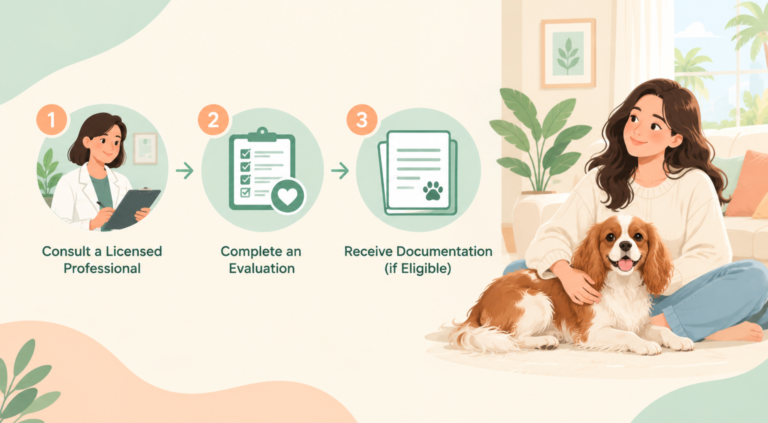
How to Request Multiple ESAs: Step by Step
Step 1: Think through each animal’s role. Write down how each one helps you.
Step 2: Check your state’s rules, including any relationship-period or evaluation requirements.
Step 3: Choose a legitimate provider that uses licensed professionals and a genuine evaluation.
Step 4: Explain each animal during the evaluation. Be honest and specific.
Step 5: Ask that the letter identify all animals clearly.
Step 6: Submit a written request to your landlord. Attach your letter, describe each animal, and offer reasonable assurances, such as vaccination records and a plan for waste and noise.
Step 7: Keep records. Save your letter, emails, and replies.
You can learn more at Healify Now’s ESA letter page, where you can connect with licensed professionals online. A letter supports your request but cannot guarantee approval.
Tips for Strengthening a Multiple-ESA Request
- Show responsibility: Keep vaccinations, licensing, and vet records current.
- Spay or neuter where appropriate, which can reduce noise and nuisance behavior.
- Train your animals to follow basic commands. See our guide on training an emotional support dog.
- Plan for space and sanitation: Litter, waste, bedding, and exercise.
- Prevent noise and damage: Enrichment and routines help.
- Offer a behavior history, if your animals have a good one.
- Be patient and polite if your landlord has questions.
Red Flags: Scams to Avoid
Proceed with caution if a website:
- Offers instant approval or promises to approve an unlimited number of animals
- Sells “ESA registration,” certificates, ID cards, and/or vests to prove that it is legitimate (there is no ESA registry)
- Sells “unlimited ESAs” at one price with no evaluation process
- Does not link you to a licensed professional
- States that landlords must consider whether to accept an unlimited number of animals
- Does not have proper contact information, return policy, and privacy policy
Final Thoughts

So, what is the maximum number of ESAs that one may keep? There is no federal cap on the number, but each animal should be needed because of some disability-related needs, and the request should be reasonable within the housing situation. Two ESAs are the most common number, and it is relatively easy to have, while larger numbers raise more questions. In 2026, when federal law enforcement will be less strict, your explanation, your evidence, and your state law will play a significant role.
Are you ready to go further? Find out more information at Healify Now and get an ESA evaluation.
Frequently Asked Questions (FAQs)
1. Is there a legal limit on how many ESAs I can have?
No fixed federal limit exists. Each animal should serve a disability-related purpose, and the request must be reasonable for your housing. Landlords evaluate each request individually.
2. Can I get one ESA letter for multiple animals?
Often, yes. A licensed professional can name more than one animal in a single letter if each supports your well-being. Some providers issue separate letters or charge extra, so ask first.
3. Can a landlord deny multiple ESAs?
Possibly, in limited cases, such as an unreasonable request for the space, a direct safety threat, substantial property damage, or an undue burden. A blanket pet limit alone isn’t a valid reason.
4. How many ESAs do professionals usually approve?
It is common for people to qualify for one or two. Getting more than two is uncommon since it is difficult to prove that each animal has a unique purpose and is compatible with the accommodation.
5. Do I have to prove each ESA helps differently?
No, but you must be able to identify why each one is necessary. Providing specific and truthful information makes it easy for the professional and the landlord to see the necessity.
6. Can I bring multiple ESAs on a plane?
No, as ESAs. Airlines usually consider ESAs as pets, and therefore the normal policies applicable to pets will apply.