

HealifyNow provides some of the services discussed in this article. Our content is written to inform, and clinical decisions are always made by a licensed clinician.
Dogs are curious creatures that are always active and get into trouble easily. From cuts from sticks during walks to torn nails and paw pad abrasions, little injuries are bound to occur. Understanding which type of bandage should be used and how it should be applied will help keep the injury safe until the dog is taken to the vet.
The article outlines the types of bandages used for dogs, how to bandage an injury, and, equally important, when a bandage is not the correct treatment option.
When You Should Skip DIY and Call a Vet
Home bandaging is reserved for trivial injuries only. Take your pet to the vet without delay when he suffers from:
- Bleeding that does not stop within about 5 to 10 minutes of applying firm pressure
- A deep wound, a gaping wound, or an injury requiring stitches
- A punctured or bitten wound that may lead to bacterial infection beneath the skin
- An injury located on the chest, abdomen, eyes, or near joints
- Possibility of bone fracture or severe pain in the affected area with lameness and a distorted limb
- Infection signs, including swelling, warmth, pus discharge, odorous wound, or red streaking
- Large, dirty, or infected wound
In such cases, apply gentle pressure with a clean cloth if bleeding occurs and go to the vet.
Can You Put a Band-Aid on a Dog?
No. Adhesive bandages don’t stay on fur, and the adhesive can irritate skin and pull painfully when removed. Use a non-stick pad and a vet-style wrap instead.
The Main Types of Dog Bandages
1. Non-stick gauze pads
These go right onto the wound itself. A non-stick (non-adherent) pad is a more suitable option for open wounds than gauze, as it won’t adhere to the healing wound tissues and tear them off while removing the bandage.
2. Rolled gauze
A roll of gauze keeps the pad in place and provides additional soft cushioning, especially on legs and feet. However, it’s seldom enough by itself.
3. Self-adhesive (cohesive) wrap
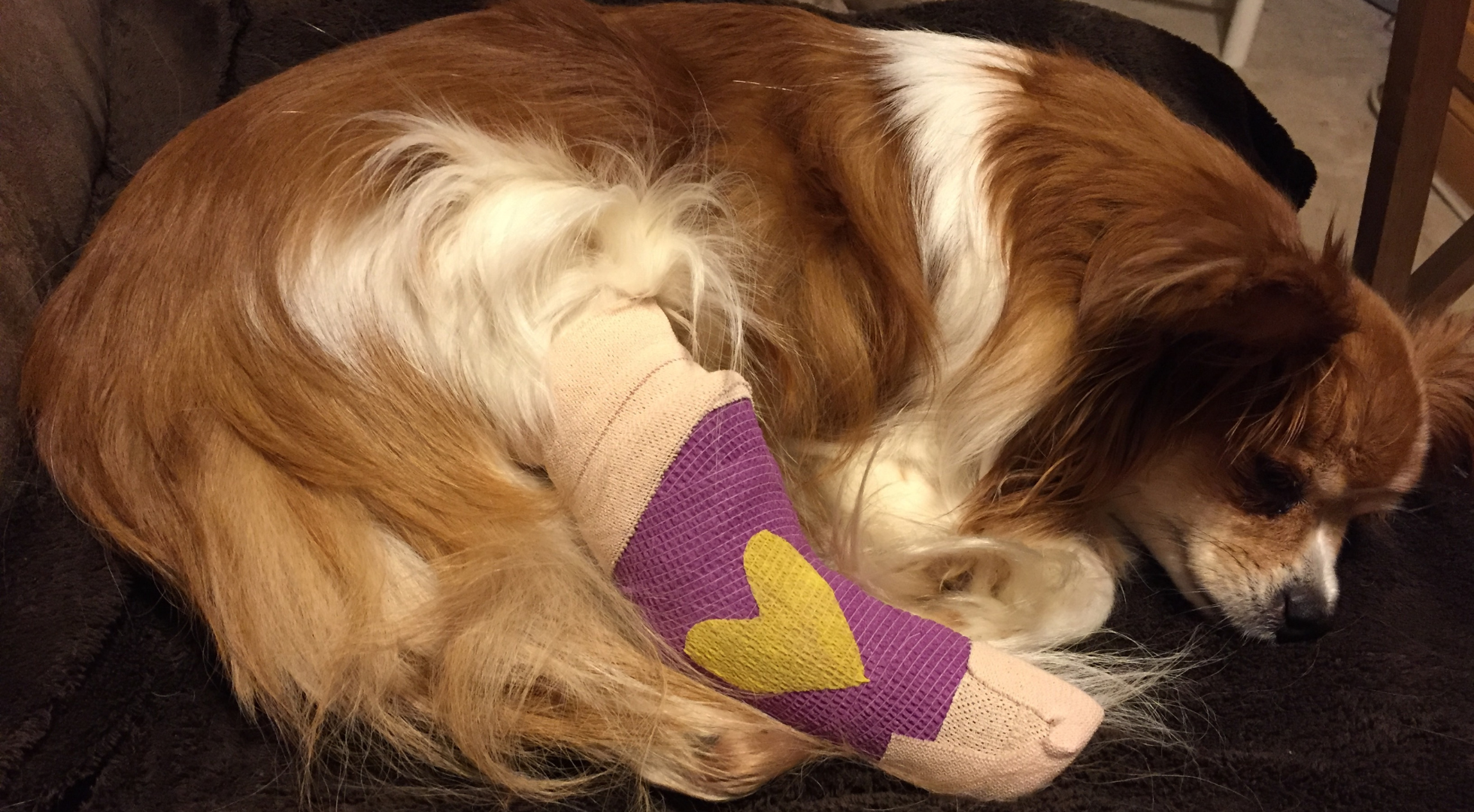
This elastic tape, usually known as the vet wrap, doesn’t adhere to the fur but to itself, which makes it an optimal bandage option for legs, feet, and tail. Wrap it loosely.
4. Elastic bandage
Elastic bandages may help to hold the dressing in place; however, they may be difficult to put on too tightly since this can result in poor blood circulation. When applying one of these bandages, always maintain moderate tightness and monitor its condition.
5. Many-tailed bandage
Rectangular bandage with multiple tails cut in at the edges to tie. This bandage is helpful when wrapping the abdomen, chest, and neck, which are the areas where bandages may slide off.
6. Liquid bandage
Not all liquid bandages are designed for minor skin abrasions in humans. Dogs tend to lick, and some bandages may be toxic or trap bacteria under the skin, so you should always consult your veterinarian before applying one.
Dog Bandage Types at a Glance
| Bandage Type | Best For | Watch Out For |
|---|---|---|
| Non-stick pad | First layer over wounds | Needs a wrap to stay in place |
| Rolled gauze | Padding and holding dressings on legs or head | Slips if used alone |
| Cohesive (vet) wrap | Outer layer on legs, paws, and tails | Too much tension can restrict blood flow |
| Elastic bandage | Securing dressings; mild compression | Easy to over-tighten |
| Many-tailed bandage | Abdomen, chest, and neck | Ties can loosen |
| Liquid bandage | Only if your vet approves | Risk if licked or if it traps bacteria |
What Should Be in a Dog First Aid Kit?
Have some of these items at home, and a separate pack of them either in your car or in your backpack:
- Non-adherent gauze pads of various sizes
- Gauze and cohesive bandage rolls
- Medical tape
- Towels or clean cloths
- Saline solution to wash wounds
- Scissors and tweezers without sharp edges
- Cones (Elizabethan Collar) or Recovery Neck Collar
- Muzzle or strips of fabric, since the injured dog can bite you
- Disposable gloves
- Telephone number of your vet and the nearest 24-hour emergency center
- Extra leash and treats
Do not keep any human painkillers near your dog. Most of them are extremely poisonous for dogs and include ibuprofen and acetaminophen; do not give your dog anything without veterinary recommendations.
How to Treat and Bandage a Minor Wound

1. Stay calm and keep your dog calm
Even the kindest dogs will bite when hurt. Speak gently, and use a muzzle if necessary. If possible, ask for assistance in holding the dog and don’t try to restrain him by force.
2. Control bleeding
Use a clean gauze or cloth, and apply pressure to the wound. Don’t lift the gauze or cloth constantly and try to inspect the wound. Usually, cuts stop bleeding after several minutes.
3. Clean the wound
Irrigate the wound with sterile saline solution or clean water. When a more thorough irrigation is required, a diluted chlorhexidine solution is usually employed. Hydrogen peroxide and rubbing alcohol should be avoided.
4. Remove surface debris
Use clean tweezers for loose materials such as grass and grit. Avoid trying to remove anything that has embedded into the skin, and if you cannot see the whole injury, get help from your vet.
5. Apply a dressing
Apply a non-adhesive pad over the injury. Be aware of some ointments and ask your vet if you should use them. There are some medications that are not advisable when the animal licks them.
6. Add padding and a wrap
Use the rolled gauze or padding to cover the pad. Make sure to use a cohesive wrap to hold the bandage. When you have a leg injury, start at the bottom and move up to avoid swelling, and overlap by 50 percent of the wrap each time.
7. Prevent chewing
A cone helps keep your dog from pulling the bandage off, which is one of the most common reasons bandages fail.
How Many Layers Should a Dog Bandage Have?
The typical limb bandage consists of three layers:
- Contact layer: Sterile, non-adherent pad on top of the wound.
- Padding layer: Composed of rolled gauze or cotton padding that helps to absorb fluid and act as a cushion.
- Outer layer: Cohesive wrapper that wraps everything up and keeps the inner layers dry.
In some cases, an additional protective layer or tape on the top edge is used to prevent the bandage from moving.
How Tight Should a Dog Bandage Be?
Snug but never tight. Too tight is dangerous. Signs of a bandage that is too tight include:
- Swollen toes or swelling above or below the bandage
- Cold toes, or toes that look pale or bluish
- Your dog licking, chewing, or whining at the bandage
- Sore or red skin at the edges
- A foul odor or discharge
If you see any of these, remove the bandage and call your vet.
Caring for the Bandage
- Keep it dry. Germs love moisture. If you go outside, put a plastic bag or boot over a foot bandage, and take it off once you return indoors. Don’t keep the plastic on for too long, as it collects moisture.
- Inspect it at least twice daily for any looseness, swelling, smell, or moisture.
- Replace it as recommended by your vet, or earlier if it becomes wet or contaminated. Most of the bandages have to be replaced within one to two days.
- Restrict your activity. Only short leash walks are recommended during the healing process.
- Look out for infections. Increasing redness, swelling, warmth, pus, or a bad smell require a visit to a vet clinic.
Where Can You Bandage a Dog?
The bandages should be placed only around the lower limbs, paws, tails, and sometimes the head or neck area. It is difficult to place bandages properly on upper limbs, shoulders, and hips, and these kinds of wounds need a professional’s help.
What About Broken Bones?
If you are not sure how to splint a broken bone, do not attempt this until the vet shows you how to do it right because otherwise you might hurt your pet even more. Try to keep your pet calm and go to the vet.
Does a Wound Always Need a Bandage?
Not always. Sometimes it is better to leave the wound without a bandage. Your vet may suggest that you use the cone or something else instead of the bandage. Listen to his advice.
Keeping Your Dog Healthy, Whatever Their Role
A healthy dog is a happier, more reliable companion, whether a pet, an emotional support animal, or a service dog. Regular vet care, preventive treatments, and quick attention to injuries help your animal stay in good shape. If you’re exploring ESA documentation for housing, you can learn more on Healify Now’s ESA Letter page.
Key Takeaways
Choose a bandage based on the wound’s location and severity, with a non-stick pad as the first layer.
- Use cohesive wrap for the outer layer, and keep tension light.
- Never use human Band-Aids, hydrogen peroxide, rubbing alcohol, or human pain medication.
- Deep, puncture, bite, eye, chest, and abdominal wounds need a vet.
- A cone helps prevent chewing, and bandages must stay clean and dry.
- Check regularly for swelling, odor, and signs the bandage is too tight.
Frequently Asked Questions
1. What is the best bandage for a dog?
A non-stick pad covered by rolled gauze and cohesive wrap works well for minor limb wounds. The best choice depends on the wound’s location and severity.
2. Can I use a human Band-Aid on my dog?
No. Adhesive bandages don’t stay on fur and can irritate the skin. Use a non-stick pad with gauze and a self-adhesive wrap instead.
3. How tight should a dog bandage be?
Snug but not tight. If toes swell, feel cold, or your dog chews at the wrap, it may be too tight. Remove it and call your vet.
4. How often should I change a dog’s bandage?
Typically once or twice daily, or even more frequently if it gets wet, dirty, or develops an odor. Consult your vet regarding specific wound treatment.
5. Can I use hydrogen peroxide to clean my dog’s wound?
Avoid doing so. Hydrogen peroxide and rubbing alcohol can irritate healthy tissues and inhibit wound healing. Use sterile saline or clean water to rinse the wound.
6. When should I take my dog to the vet instead of bandaging at home?
If your dog has a deep cut, a puncture or bite wound, heavy or incessant bleeding, a possible bone fracture, or wounds around the eyes, chest, and abdomen.