Physician
- ESA letters
- PSD letters
- Clinical evaluations
Andrew Patel, MD
Reviews each evaluation and issues HealifyNow's emotional support animal and psychiatric service dog letters.

Semaglutide
Labs & testing
Hair, skin & wellness
Mobile IV therapyMeet with a licensed mental health professional by secure telehealth. If a psychiatric service dog is part of your care, you receive a signed PSD letter documenting your disability-related need — ready for housing and workplace accommodation requests.
Law check · updated November 12, 2026
General information, not legal advice. Letters are issued only if a licensed clinician decides you qualify. See our disclaimer and editorial policy.
Arizona's service animal statute, A.R.S. 11-1024, is detailed and explicitly covers dogs that are still in training. For handlers in Phoenix, Tucson or Flagstaff it works alongside the ADA, and a PSD letter plays no part in public access.
The statute defines a service animal as any dog or miniature horse that is individually trained, or in training, to do work or perform tasks for a person with a disability. Other species are excluded. Operators of public places, a term that covers businesses, offices, recreation sites and all forms of conveyance, may not discriminate against people who use service animals.
Staff may ask whether the animal is a service animal required because of a disability and what work or task it has been trained to perform. They may not demand other disability-related information, require identification for the animal, or charge a fee or deposit because of it. A no-pets policy cannot be used to keep a service animal out.
An animal can be excluded if it poses a direct threat, is out of control without effective action by the handler, is not housebroken, or if admitting it would fundamentally alter the business or impose an undue burden. The person must then be allowed to return without the animal. Subsection G lets a trainer or a person with a disability bring an animal into public places to train it.
Violating the access provisions is a class 2 misdemeanor. On the other side, fraudulently misrepresenting an animal as a service animal, or as one in training, can lead to a civil penalty of up to $250 per violation imposed by a court or hearing officer.
Checked . General information, not legal or medical advice. How we research
Psychiatric service dogs are protected by federal law in all 50 states, and Arizona law may add further protections. Here is where a letter actually helps.
 Arizona
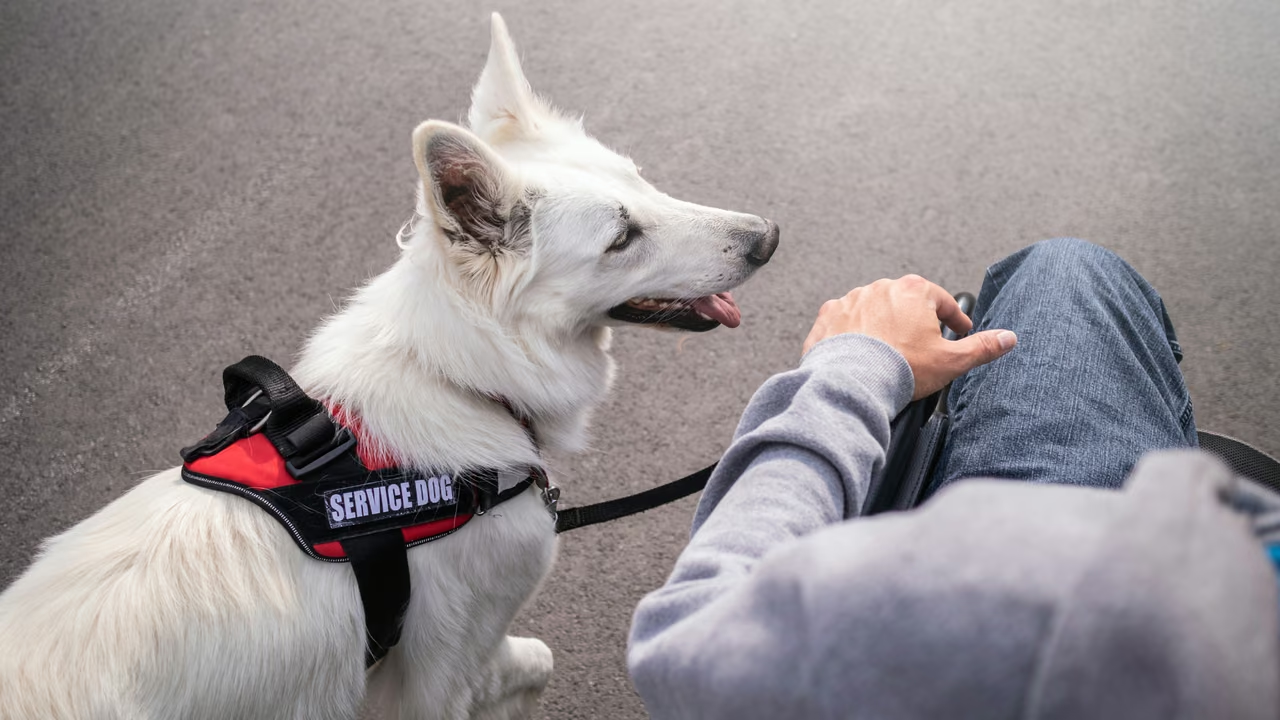
A psychiatric service dog is trained to do specific tasks; in Arizona, a PSD letter documents why you need one.
Under the Fair Housing Act, Arizona landlords, HOAs, and property managers must reasonably accommodate your PSD — including in no-pet buildings — without pet rent or deposits. When your disability isn't obvious, they may ask for reliable documentation. Your letter is that documentation.
Bringing a service dog to work is a reasonable accommodation request under the ADA. Employers may ask for documentation of your disability and need, and a clinician's letter supports that conversation with HR.
Stores, restaurants, and hotels in Arizona can't demand paperwork for a service dog. Access depends on your dog being task-trained and under control, so no letter is needed at the door.
Airlines accept trained psychiatric service dogs in the cabin and may ask you to complete the DOT Service Animal Air Transportation Form. Emotional support animals no longer qualify.
Two things must be true: you have a mental health condition that substantially limits a major life activity, and your dog is trained to perform specific tasks that help with it.
Hypervigilance, flashbacks, nightmares
Panic attacks, severe generalized anxiety
Major depressive disorder, persistent depression
Bipolar disorder, OCD, and more
Comfort alone isn't a task — that describes an emotional support animal. Tasks look like this:
Real evaluation, not a rubber stamp — and you only pay if you're approved.
Answer a short confidential questionnaire about your symptoms, history, and your dog's tasks.
A licensed mental health professional evaluates you by secure video or phone and decides whether a psychiatric service dog is appropriate.
If approved, you pay and receive your letter by secure email within about 10 minutes — print-ready PDF with your clinician's license details.
Same price in every state. Free to book, and you only pay after the clinician approves your letter.
Emotional support animal · up to 2 pets
Emotional support animal · 3 or more pets
Psychiatric service dog · up to 2 dogs
Psychiatric service dog · up to 3 dogs
Telehealth means the same care in every county and ZIP code — from Phoenix and Tucson to rural Arizona.
Be wary of sites selling instant "certifications," ID cards, or registry numbers — none are legally required, and none replace a real evaluation or real training. Many states penalize misrepresenting a pet as a service animal. A legitimate letter comes from a licensed clinician who actually evaluated you.
After your evaluation, your letter is reviewed and signed by one of our letter clinicians.
Reviews each evaluation and issues HealifyNow's emotional support animal and psychiatric service dog letters.
Conducts mental health evaluations and issues HealifyNow's emotional support animal and psychiatric service dog letters.
HealifyNow's medical care is overseen by independently licensed U.S. physicians. PSD evaluations are performed by licensed mental health professionals.

A board-certified physician who brings a rigorous, pharmacology-driven lens to longevity medicine and weight management.

A Columbia-trained physician and former collegiate athlete focused on metabolic function, body composition, and healthspan.

A board-certified OB-GYN and ACOG Fellow with more than four decades of experience in women's health.
Yes. A.R.S. 11-1024 includes dogs in training in its definition of service animal, and subsection G allows a trainer or a person with a disability to take the animal into public places for training on the same terms as a trained service animal.
A court or duly appointed hearing officer may impose a civil penalty of up to $250 for each violation of the misrepresentation rule in A.R.S. 11-1024. The rule also covers falsely presenting an animal as one in training.
A.R.S. 11-1024 bars public places from charging a fee or deposit because of a service animal and from requiring identification for it. You can be asked the two permitted questions, and you remain responsible for any damage.
Yes — when it comes from a licensed mental health professional after a real evaluation. HealifyNow matches you with a licensed clinician who assesses whether you have a mental health disability and whether a task-trained service dog helps with it. If you don't qualify, no letter is issued and you aren't charged.
Under the federal Fair Housing Act, housing providers in Arizona must make reasonable accommodations for assistance animals, including psychiatric service dogs, even in "no pets" buildings — and pet rent and pet deposits are generally waived for them. A landlord can deny a specific animal only for narrow reasons, such as a direct threat to others' safety or substantial property damage that can't be reduced. You remain responsible for any damage your dog causes.
No. Under the ADA, businesses in Arizona can't require documentation, ID, or certification for a service dog. Staff may ask only two questions: whether the dog is required because of a disability, and what work or task it has been trained to perform. Your dog's public-access rights come from its training and behavior, not from a letter. A PSD letter is most useful for housing and workplace accommodation requests.
Book free, meet a licensed clinician, and pay only if you're approved. Your letter arrives minutes after approval.