

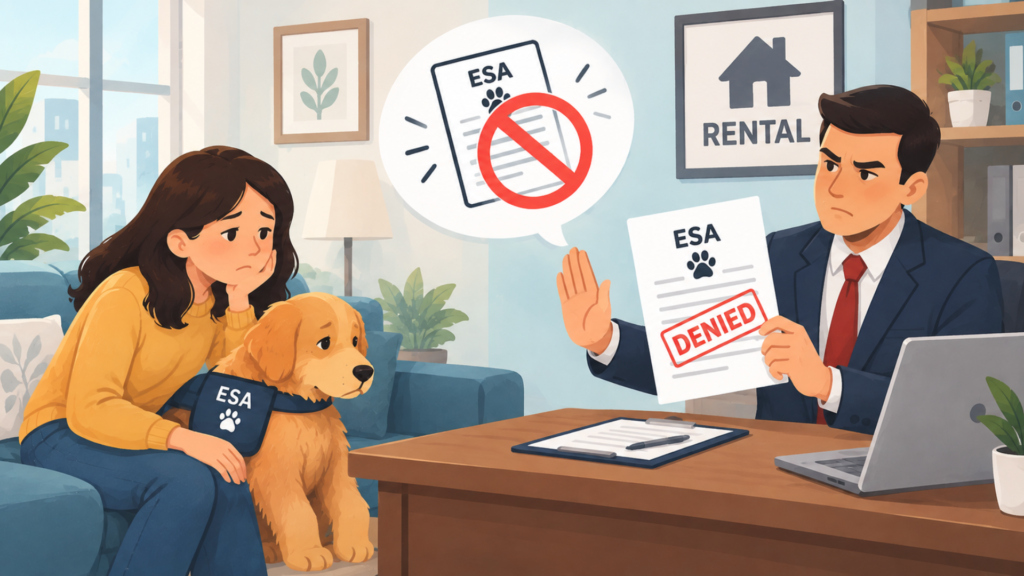
The right apartment has been found, you’ve provided your ESA letter, and the landlord refuses. Can the landlord refuse the request? Usually, he or she cannot. There are, however, instances where the refusal is justified.
In this guide, we answer the question of when a landlord can refuse an ESA in Texas. We provide the grounds for refusal and actions you should undertake if you think that the landlord has treated you unfairly.
How ESA Housing Rights Work in Texas
Texas does not have its own ESA law replacing federal protections. The laws you need to know are:
- The federal Fair Housing Act (FHA) forbidding discrimination against individuals with disabilities in housing and requiring accommodation
- Texas Fair Housing Act (Texas Property Code, Chapter 301), which is similar to the federal one and is enforced by the Texas Workforce Commission
As per the laws stated above, your ESA will be considered an assistance animal and not a pet. Therefore, the “no pet” clause in the lease agreement cannot be used against you.
What Is an ESA Letter?
ESA Letter: The letter in question is a written document prepared by an LMHP (licensed mental health professional) certifying the existence of your mental or emotional disability and mentioning the assistance of your animal in coping with it. It is an official document used to seek a reasonable accommodation in the matter of housing.
Features of a valid letter are as follows:
- Name and credentials of the professional who has issued the letter
- Date when the letter was issued
- Statement about your condition which can be improved with an ESA
- Information about the animal covered
- Signature of the professional and his/her contact details
Your diagnosis should not necessarily be specified in the letter.
When Can a Landlord Legally Reject an ESA in Texas?
A landlord can lawfully deny or limit an ESA request only in specific situations. The most common are below.
1. The Housing Is Exempt From the FHA
Housing is excluded from the federal FHA regulations in some situations. Some examples of exclusions are as follows:
- Buildings that contain four units or fewer, where the owner occupies one unit
- Some single-family housing which is sold or rented by the owner who uses no agent and does not own more than three similar units
- Private clubs or religious organizations which provide housing restricted to its members, in certain instances
If your housing is exempted from these categories, then the landlord might not be legally bound to allow you an ESA.
2. The Animal Poses a Direct Threat
The owner of the rental property may deny the particular animal if the animal poses a threat to the health and safety of other people and if this threat cannot be mitigated by any other accommodation. This refusal should be based solely on individual facts concerning the threat of the animal and not on the breed or size of the animal in question.
3. The Animal Would Cause Substantial Property Damage
A landlord may deny the animal if it will cause substantial physical damage to the property of other individuals and cannot be mitigated by another reasonable accommodation.
4. The Request Imposes an Undue Burden
A landlord may refuse to accommodate the request because it creates an undue financial and administrative burden or because it would substantially change the nature of the landlord’s housing operations. It is a rare case when an owner of the housing will prove such a burden from the presence of a single ESA.
5. There Is No Disability-Related Need or Reliable Documentation
If your disability and your need for the animal aren’t obvious, a landlord can ask for reliable documentation from a licensed professional who knows your situation. They may lawfully question a request if:
- The documentation is missing or unreliable
- The letter doesn’t come from a qualified licensed professional
- The documentation doesn’t connect your need to the animal
This is one of the most common reasons ESA requests get delayed or denied, and it’s why a legitimate provider matters.
6. The Animal Is Unusual
Dogs and cats are the most commonly accepted ESAs. If the animal is unusual or not commonly kept in households (for example, exotic species), a landlord may ask for more information to show the need for that particular animal.
What a Texas Landlord Cannot Do
Generally, a landlord cannot:
- Reject your ESA because of a “no pets” policy
- Charge pet rent, a pet deposit, or a pet fee for an ESA
- Reject your animal solely because of its breed, size, or weight
- Demand your medical records or specific diagnosis
- Require the animal to be trained, certified, or registered
- Require it to wear a vest or ID
- Refuse to rent to you or retaliate against you for requesting an accommodation
- Ignore your request without responding
A landlord can charge for actual damage your animal causes, just like with any tenant.
Common Situations in Texas Housing
Apartments and rental homes:
Most are covered by the FHA, so the rules above generally apply.
HOAs and condo communities:
Homeowners associations are generally subject to fair housing laws, so a “no pets” or breed rule typically can’t be applied to a valid ESA request. Check your HOA’s accommodation process.
Student and campus housing:
Colleges and universities usually have their own process for assistance animals. Contact the disability services or housing office early.
Mobile home communities:
Many are covered by fair housing law, though specific circumstances can vary.
ESA vs. Service Animal vs. Pet
- Emotional Support Animal: Offers companionship for emotional support. No special training is needed. The protection only pertains to housing situations.
- Service Animal: According to the Americans with Disabilities Act (ADA), this is a dog (or miniature horse in a few situations) that is individually trained to do tasks for an individual with a disability.
- Pet: Offers companionship and does not have special protection.
How to Protect Yourself Before You Apply
Step 1: Get a valid letter
Work with a provider that connects you with a licensed professional who evaluates you.
Step 2: Make your request in writing
Email is fine. Attach your letter and keep it brief and polite.
Step 3: Describe your animal
Include the type of animal and the number of animals, if relevant.
Step 4: Apply early
Ideally, submit your request before signing the lease or moving in, though you can request an accommodation later.
Step 5: Keep records
Save your letter, your messages, and any replies.
You can begin at Healify Now’s ESA letter page to connect with a licensed professional online.
What to Do If a Texas Landlord Rejects Your ESA
- Ask for the reason in writing. A lawful denial should rest on a specific reason, not a blanket policy.
- Respond calmly and provide any missing documentation. If the denial is about the letter, a valid, complete letter may resolve it.
- Cite your rights politely. Mention that you are requesting a reasonable accommodation under fair housing law.
- Keep everything in writing. Dates, messages, and notices matter if a dispute escalates.
- File a complaint if needed. You can file with the U.S. Department of Housing and Urban Development (HUD) or the Texas Workforce Commission Civil Rights Division. Complaint deadlines apply, so act promptly.
- Consider legal help. A tenant attorney or a local fair housing organization can advise you on your options.
Why Choose an Online ESA Evaluation?
- Convenience: Speak with a professional from home.
- Speed: Faster than scheduling an in-person appointment.
- Privacy: Discuss sensitive matters in a comfortable setting.
- Accessibility: Helpful if you live in a rural area or have a busy schedule.
- Less stress: No commute and no waiting room.
A trusted platform like Healify Now connects you with licensed professionals, so your documentation is credible and landlord-ready.
Red Flags: How to Spot a Fake ESA Letter Provider
A poor letter is one of the simplest ways to lose a housing dispute. Take care if a website:
- Guarantees approval without an evaluation process
- Sells “ESA registration” or “certification” (there is no ESA registry, and registration is not required by law)
- Provides no information about review by a professional
- Encourages purchasing an ID card, vest, or badge as ESA proof
- Has no way of contacting them or a privacy policy
Legal Points to Know in Texas
- Your animal must behave. An ESA that is aggressive or destructive can lose its housing protection.
- Keep your letter current. Many landlords prefer letters issued within the past 12 months.
- Follow local rules. Vaccinations, licensing, and leash laws still apply.
- You’re responsible for damage, just like any tenant.
- Don’t misrepresent your animal. Texas and federal rules take false claims seriously, so be honest about your animal’s role.
- Laws and enforcement change. Check current Texas and local rules or speak with an attorney for specific situations.
Tips for a Smooth Request
- Be honest about your needs and your animal.
- Use a licensed provider and a complete, signed, dated letter.
- Stay polite and professional if your landlord has questions.
- Keep your animal healthy and well-behaved.
- Save every message and document.
- Renew annually to keep your documentation current.
Final Thoughts
Thus, when is a landlord allowed to deny an ESA in the State of Texas? In very few situations – exempt housing, safety concerns, extensive damages to the property, an undue burden, or inadequate documentation. A “no pets” policy, breed restrictions, and pet deposits are not good grounds for denying an ESA under the law. Begin with a legitimate ESA letter, communicate in writing, and know whom to contact if your rights are violated.
Get started now! Find more information about your ESA evaluation here at Healify Now.
Frequently Asked Questions (FAQs)
1. Can a Texas landlord deny an ESA because of a no-pets policy?
No. A “no pets” policy generally can’t be used to reject a valid ESA request. Under fair housing law, an ESA is an assistance animal, not a pet, unless the housing is exempt.
2. Can a landlord charge pet rent or a deposit for my ESA in Texas?
Generally no. Landlords usually can’t charge pet fees, rent, or deposits for a valid ESA. You can still be charged for actual damage the animal causes.
3. Can a landlord reject my ESA because of its breed or size?
Generally not. A landlord can deny a specific animal only if there’s objective evidence that it poses a direct threat or would cause substantial damage, not because of breed or weight alone.
4. Can a Texas landlord ask for my diagnosis or medical records?
No. While they can ask for credible proof if your requirement is not self-evident and they may confirm the credibility of the letter, they cannot request your diagnosis or medical records.
5. Which Texas housing doesn’t have to accept ESAs?
Some types of housing are exempt, like certain owner-occupied dwellings with 4 or fewer units and some privately owned single-family homes that are leased without the help of a broker.
6. Where can I file a complaint if my ESA is wrongly denied?
You may file a complaint with HUD or the Texas Workforce Commission Civil Rights Division. There are time limitations, so you must file within the appropriate period.